 English
 русский
Industry News
Home / News / Industry News / Aluminum Alloy Diaphragm Pump Casting Factory: The Foundry That Pours the Heart of the Pump

2026-09-04
A diaphragm pump moves chemicals, slurries, and food products without the fluid ever touching a piston or a gear. The pump body is the chamber. The diaphragms flex. The fluid flows through. The body has to be pressure-tight, corrosion-resistant, and dimensionally stable. An aluminum alloy diaphragm pump casting factory produces these pump bodies, manifolds, and air motor housings by pouring molten aluminum into steel molds. The casting quality is set in the foundry, and it cannot be fixed downstream. For pump assemblers and industrial equipment brands, the foundry is the first quality gate.
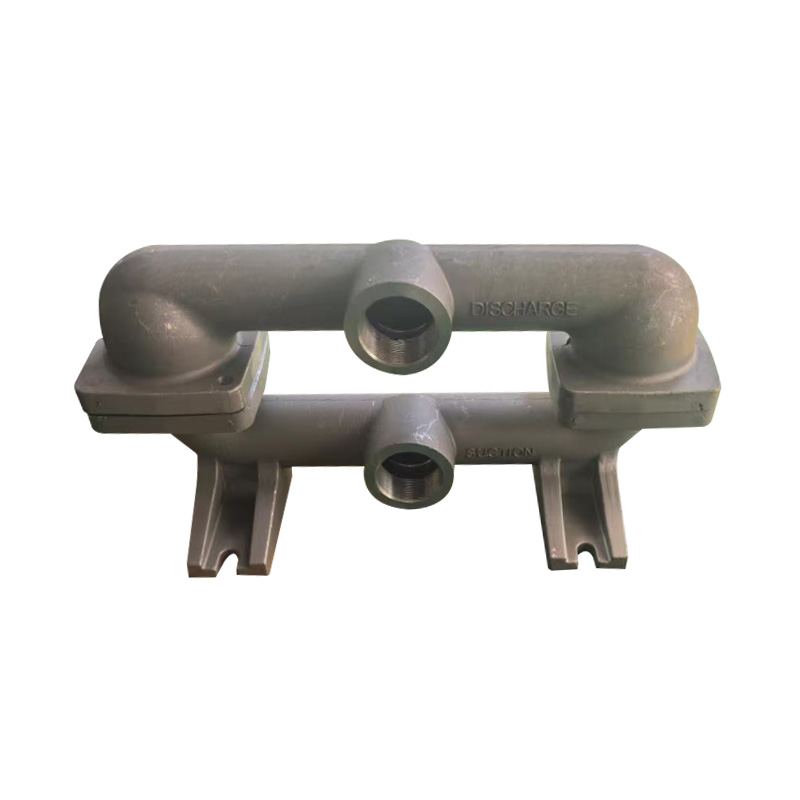
Not all aluminum is the same. A diaphragm pump casting factory uses casting-grade alloys, typically A356 or an equivalent, with controlled silicon content for fluidity and strength. The alloy has to flow into thin-walled sections without freezing early, hold pressure without leaking, and resist corrosion from the fluids the pump will move.
The melt chemistry is verified per heat. A diaphragm pump casting factory takes a spectrometer reading before pouring to confirm the alloy composition. A heat that drifts out of spec produces castings that fail pressure testing or corrode prematurely in service.
Porosity is the constant enemy. Hydrogen dissolves in molten aluminum and comes out of solution as the metal solidifies, leaving gas pockets. A diaphragm pump casting factory degasses the melt with inert gas purging or tablet degassers before pouring. Shrinkage porosity forms when the casting solidifies unevenly. Proper gating and riser design feeds the thick sections as they shrink.
The mold is the negative of the pump body. A diaphragm pump casting factory uses gravity casting, low-pressure casting, or high-pressure die casting depending on the part size, the volume, and the pressure requirements. Gravity casting into steel or sand molds works for large pump bodies and low-volume runs. Die casting works for high-volume production of smaller housings with tighter tolerances.
The gating system delivers the molten aluminum into the cavity. The gate position and size determine whether the metal fills the cavity completely before it begins to freeze. A diaphragm pump casting factory designs the gating for each part geometry so the melt reaches every section at the right temperature and speed.
The risers feed the casting as it solidifies. Aluminum shrinks as it cools. Without risers to supply additional molten metal, the casting develops shrinkage cavities in the thick sections. A diaphragm pump casting factory places risers strategically and cuts them off during finishing.
The raw casting is not a finished part. It has machined surfaces where the diaphragms seat, where the manifolds bolt on, and where the air valve mounts. The casting needs enough stock in these areas to clean up during machining without requiring excessive removal. A diaphragm pump casting factory holds the casting dimensions to tolerances that allow consistent machining setups.
The surface finish in the as-cast condition affects pump performance. A rough surface in the fluid chamber creates turbulence and traps product. A diaphragm pump casting factory controls the mold coating and pouring temperature to produce castings with a surface finish appropriate for the application. Food-grade pumps need smoother internal surfaces.
The parting line where the mold halves meet leaves a witness line on the casting. A diaphragm pump casting factory finishes the parting line flush so it does not interfere with gasket sealing or create a stress riser.
Every pump body holds pressure. A diaphragm pump casting factory pressure-tests each casting or batch samples per the customer's specification. Air or water under pressure reveals the porosity that visual inspection misses. The casting that weeps at a pinhole is scrap.
Dimensional inspection verifies the casting matches the drawing. A diaphragm pump casting factory uses CMM measurement or fixture gauging to check the critical dimensions. The machined surfaces have to be in the right place. The bolt holes have to line up. The flange faces have to be flat.
The quality documentation follows the casting. Material certs, pressure test reports, dimensional reports. A diaphragm pump casting factory that provides the paperwork gives the pump assembler traceability back to the heat and the mold.
Here is what an aluminum alloy diaphragm pump casting factory has to deliver:
The casting leaks. The pressure test catches it if the factory tests. A diaphragm pump casting factory that skips pressure testing ships leakers. The pump assembler finds them on their own test stand, and the cost is multiplied.
The casting machines poorly. Hard spots from improper solidification dull the tools. Porosity shows up as voids on the machined surface. A diaphragm pump casting factory that controls the melt and the solidification produces castings that machine predictably.
The casting warps after machining because internal stress was not relieved. A diaphragm pump casting factory that heat-treats the castings before machining removes the residual stress. The part stays flat and dimensionally stable.
A diaphragm pump casting factory pours the aluminum that becomes the pump. The alloy is right. The porosity is controlled. The casting holds pressure. The machinist gets a part that cleans up where it should. The pump goes together and moves fluid. That is the foundry's contribution, and it is set in the first minute the metal hits the mold.
Copyright © Zhejiang Xiafeng Precision Die Casting Co., Ltd.
China Air Operated Double Diaphragm Pump
