 English
 русский
Industry News

Infinite Speed Reducer: Smooth Adjustment Across a Continuous Range
2026-06-19
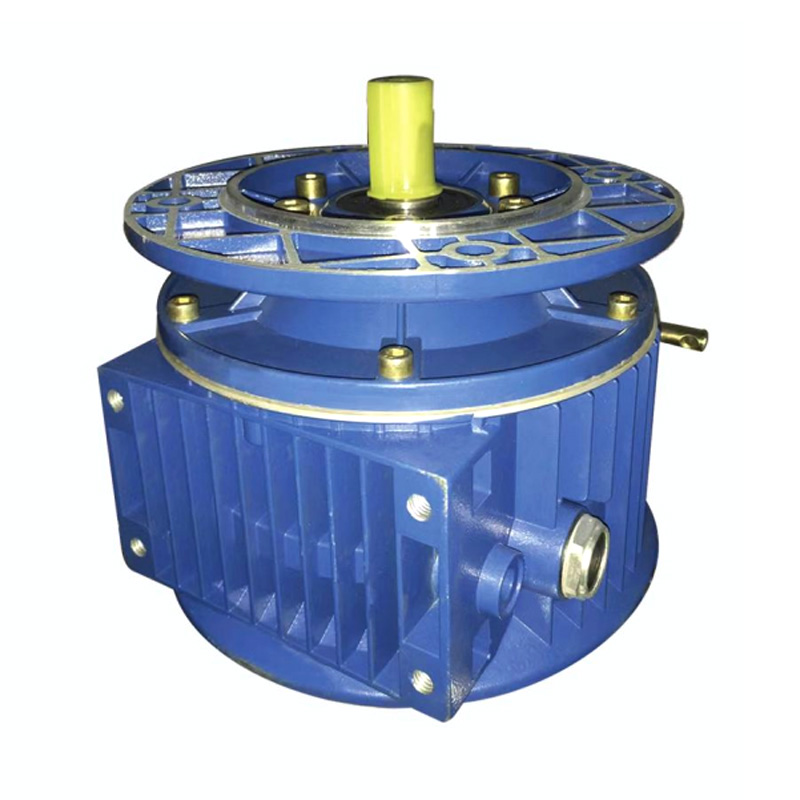
Manygearboxes give you a fixed ratio. You get one output speed for a given input speed, and that is it. If you need a different speed, you change the gearbox or swap belts. An infinite speed reducer works differently. It lets you adjust the output speed continuously across a range. Turn a dial or move a lever, and the speed changes gradually. No steps. No jumps. No stopping the machine to make the adjustment.
Infinite speed reducer is a broad term that covers several mechanical designs. Friction drives, belt drives with variable pulleys, traction drives, and hydrostatic systems all fall into this category. Each works differently, but they share the same goal: provide variable output speed without requiring an electronic drive.
How It Works
Take a common type of infinite speed reducer — the variable belt drive. Two pulleys, each made of two halves that can slide closer together or farther apart. A wide belt connects them. When the pulley halves move apart, the belt drops lower into the groove. The effective diameter gets smaller. When the halves move together, the belt rides higher. Effective diameter increases.
Change the effective diameter on the input pulley and output pulley at the same time, and the ratio changes. infinite speed reducer units use a screw or lever mechanism to move the pulley halves. The operator turns a handle. Output speed changes smoothly. No jerks. No sudden ratio shifts.
Other designs achieve the same result differently:
- Friction disc designs — a wheel rolls across the face of a spinning disc. Move the wheel toward the center for slower output. Move it toward the edge for faster output.
- Traction drives — steel balls or rings transmit power through a thin oil film. Tilting the rolling elements changes the ratio.
- Hydrostatic systems — a variable pump drives a hydraulic motor. Change the pump's displacement to change output speed.
Common Applications
Any machine that needs adjustable speed during operation can use an infinite speed reducer. Conveyor lines are a classic example. A packaging line might run slower for one product and faster for another. The operator adjusts the infinite speed reducer while the line keeps moving. No belt changes. No stopping to swap gears.
Mixers and agitators benefit too. Thin liquids mix fine at low speed. Thick pastes need higher speed to move around the tank. An infinite speed reducer lets the operator dial in the right speed without guessing.
Other places you will find an infinite speed reducer:
- Machine tool feeds — adjust cutting speed without stopping the spindle
- Testing equipment — vary load speed across a smooth range
- Winding stands — maintain constant tension by adjusting speed on the fly
- Food processing — change line speed for different product sizes
Why Choose Mechanical Variable Speed
An infinite speed reducer competes with variable frequency drives and electronic speed controls. So why pick the mechanical option? For some applications, simpler is better.
An infinite speed reducer needs no electrical work. No programming. No control panel. Any operator can turn a handle or move a lever. No training required.
Harsh environments are another reason. Electronics do not like heat, dust, moisture, or vibration. An infinite speed reducer keeps working when a VFD would fail. No circuit boards to seal. No fans to clog.
Cost matters too. For smaller machines, an infinite speed reducer is often cheaper than a VFD and a compatible motor. No three-phase power needed. No control enclosure to buy.
Key advantages of an infinite speed reducer:
- Smooth, continuous adjustment without stopping the machine
- Simple mechanical operation — turn a handle, speed changes
- Works in harsh conditions where electronics struggle
- Lower upfront cost for smaller horsepower applications
Limitations to Consider
An infinite speed reducer is not superb. Efficiency is usually lower than a fixed-ratio gearbox. Friction drives and belt drives waste some power as heat. You pay for the convenience of variable speed with higher energy use.
Torque capacity can be a problem. Many infinite speed reducer designs transmit less torque than a comparable gearbox, especially at bad ratio settings. Very low output speeds may come with reduced torque. Very high speeds may cause heat buildup.
Maintenance is higher too. Belts wear out. Friction discs need resurfacing. Traction drives require special fluids. An infinite speed reducer needs more attention than a simple gearbox.
Noise is another factor. Some designs, particularly ball-type traction drives, whine at certain speeds. Fine in a noisy factory. Maybe an issue in a quiet lab.
Selecting the Right Unit
Not every infinite speed reducer fits every job. Look at the speed range you need. Some units offer a 6:1 range — output can vary from one-sixth of input speed up to full input speed. Others go to 10:1 or even 20:1. More range usually means more cost and lower efficiency.
Torque requirements matter. An infinite speed reducer sized for a light conveyor will not survive on a heavy mixer. Check torque ratings at both low and high speed settings.
Environment matters. A belt drive works fine in clean, dry conditions. A traction drive with oil bath handles dust and moisture better. A hydrostatic system can be sealed completely but costs more.
A Flexible Alternative
For applications that need variable speed without electronics, an infinite speed reducer is worth a look. It is not the efficient option. It needs more maintenance than fixed gearing. But the ability to dial in exactly the right speed while the machine runs solves problems that gearboxes cannot handle.
CATEGORY
Message Feedback
Copyright © Zhejiang Xiafeng Precision Die Casting Co., Ltd.
China Air Operated Double Diaphragm Pump
