 English
 русский
Industry News
Home / News / Industry News / Auto Parts Pressure Die Casting Mold: The Tooling That Shapes Metal Under Bad Pressure

2026-08-21
Molten aluminum enters a steel mold at high speed. The mold closes under tons of clamping force. The metal solidifies in seconds. The mold opens. A robot extracts a near-finished automotive part. An auto parts pressure die casting mold produces brackets, housings, engine mounts, and transmission cases by forcing liquid metal into a hardened steel cavity under pressure. The mold is not a container. It is a precision tool that shapes complex geometries with wall thicknesses down to a few millimeters, at cycle times measured in seconds, for production runs that span hundreds of thousands of parts. Here is what automotive tier suppliers and component buyers need to know.
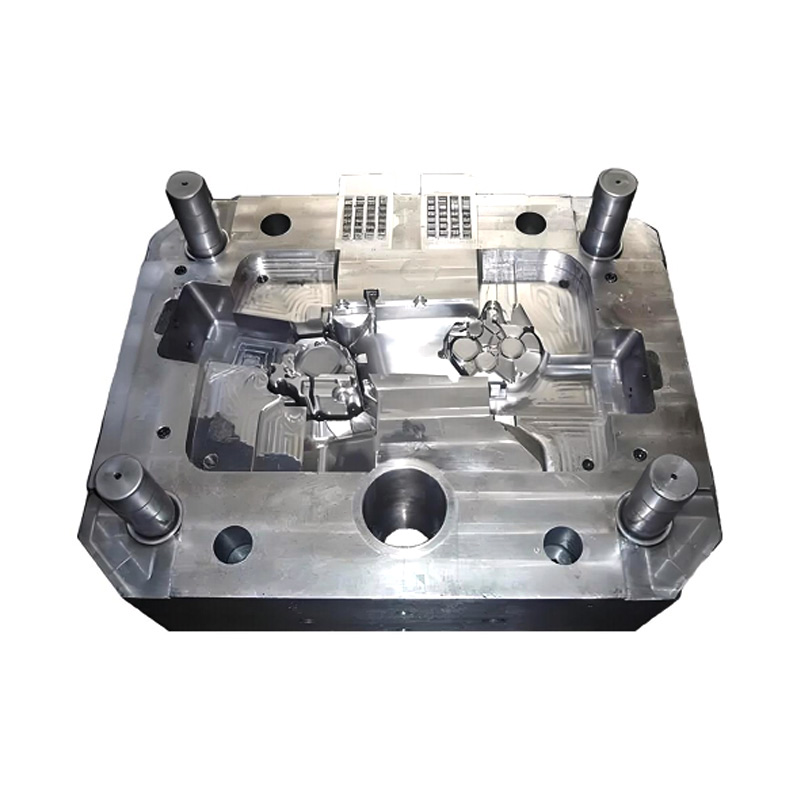
Molten aluminum at 700 degrees Celsius hits the mold surface at high velocity. The steel has to resist heat checking, erosion, and soldering. An auto parts pressure die casting mold uses hot-work tool steel, typically H13 or DIN 1.2344, hardened to 46 to 50 HRC. The steel holds its hardness at elevated temperatures and resists the thermal fatigue that cracks lesser materials.
Heat checking is the mold's life limit. Every shot heats the cavity surface. The release agent cools it. Repeated thermal cycling produces a network of fine surface cracks. An auto parts pressure die casting mold manufacturer controls the steel microstructure through proper heat treatment and stress relieving. A mold with properly treated H13 runs hundreds of thousands of shots before heat checking becomes visible on the cast parts.
The die surface coating extends life further. Nitriding or PVD coatings like AlCrN create a hard, chemically inert surface layer. The coating resists soldering, where aluminum sticks to the steel and builds up. An auto parts pressure die casting mold with a nitrided cavity surface produces cleaner parts and runs longer between cleaning cycles.
The cavity is the negative of the finished part. Every rib, boss, hole, and flange is machined into the steel. An auto parts pressure die casting mold manufacturer programs CNC machines to cut the cavity geometry from solid blocks of tool steel. High-speed machining produces fine surface finishes that reduce the need for polishing.
The parting line is where the two mold halves meet. Its location determines the direction of mold opening and the position of witness lines on the part. An auto parts pressure die casting mold designed with the parting line along a non-critical edge keeps witness lines off sealing and mounting surfaces. The parting surfaces are ground flat to prevent flash, where liquid metal squeezes into the gap and leaves a thin fin on the part.
Draft angles let the solidified part release from the cavity. Aluminum shrinks onto the cores as it cools. Without draft, the part sticks and the ejector pins push through it. An auto parts pressure die casting mold with draft angles appropriate for the wall depth and alloy releases cleanly without distortion.
The runner system delivers metal into the cavity. The gate is the entry point where the runner meets the part. An auto parts pressure die casting mold manufacturer designs the gate location and size so the metal fills the cavity before it begins to solidify. A gate that is too small causes premature freezing and short shots. A gate that is too large leaves a thick remnant that requires extra trimming.
Venting lets air escape ahead of the metal front. Trapped air compresses and heats, causing porosity in the finished part. An auto parts pressure die casting mold with vent channels and overflow pockets captures the gas and allows clean metal to fill the cavity. Vacuum systems on high-end molds pull air out before injection for near-zero porosity in critical structural parts.
Cooling channels drilled through the mold control the die temperature. Consistent die temperature means consistent solidification. An auto parts pressure die casting mold manufacturer designs cooling circuits that follow the cavity contour. Hot spots in the die cause uneven shrinkage and dimensional variation. Conformal cooling, where channels follow complex part shapes, reduces cycle time and improves part consistency.
Here is what a die casting mold needs for production life:
The part sticks to the die after solidification. Ejector pins push it off the core. An auto parts pressure die casting mold manufacturer positions ejector pins on ribs, bosses, and non-appearance surfaces. Pin marks on a sealing face create leak paths. Pin marks on a structural rib are invisible in service.
Slides and cores form undercuts and internal passages. A hydraulic or mechanical slide pulls the core out of the part before ejection. An auto parts pressure die casting mold with properly timed slides produces complex geometries without secondary machining. The slide mechanism has to move freely under high temperatures and resist galling from repeated cycling.
Porosity is the enemy of structural automotive parts. Gas pores weaken the material and leak under pressure. An auto parts pressure die casting mold designed with adequate venting, controlled gate velocity, and proper cooling produces parts with small porosity. The mold is not the only variable, but it sets the boundary conditions.
Mold maintenance intervals determine uptime. An auto parts pressure die casting mold manufacturer that provides a maintenance schedule, spare ejector pins, and spare slides keeps the mold running between scheduled rebuilds. A mold that runs to failure costs more in lost production than the mold itself.
An auto parts pressure die casting mold takes liquid metal and turns it into a solid automotive component in seconds. The mold works under heat, pressure, and erosion through hundreds of thousands of cycles. Choose a manufacturer that selects the right steel, designs the fill and cooling for consistency, and builds the ejection and slides for reliable cycling. The parts will come out clean, on spec, and on time. That is the output that matters.
Copyright © Zhejiang Xiafeng Precision Die Casting Co., Ltd.
China Air Operated Double Diaphragm Pump
